★
Leadership begins with a belief in people.
Leadership begins with the conviction that people possess dignity, agency, judgment, creativity, and the capacity to grow. Everything else follows from that belief.
Worth Following brings together a leadership philosophy, doctrine, and Leadership Model developed through more than four decades of leading in military service, business, and organizational life.
It begins with a belief in people—and with the conviction that the conditions leaders create determine whether people merely participate or choose to contribute their best.
These beliefs do not attempt to explain the entire doctrine. They establish the worldview from which the Worth Following Leadership Model follows.
Leadership begins with the conviction that people possess dignity, agency, judgment, creativity, and the capacity to grow. Everything else follows from that belief.
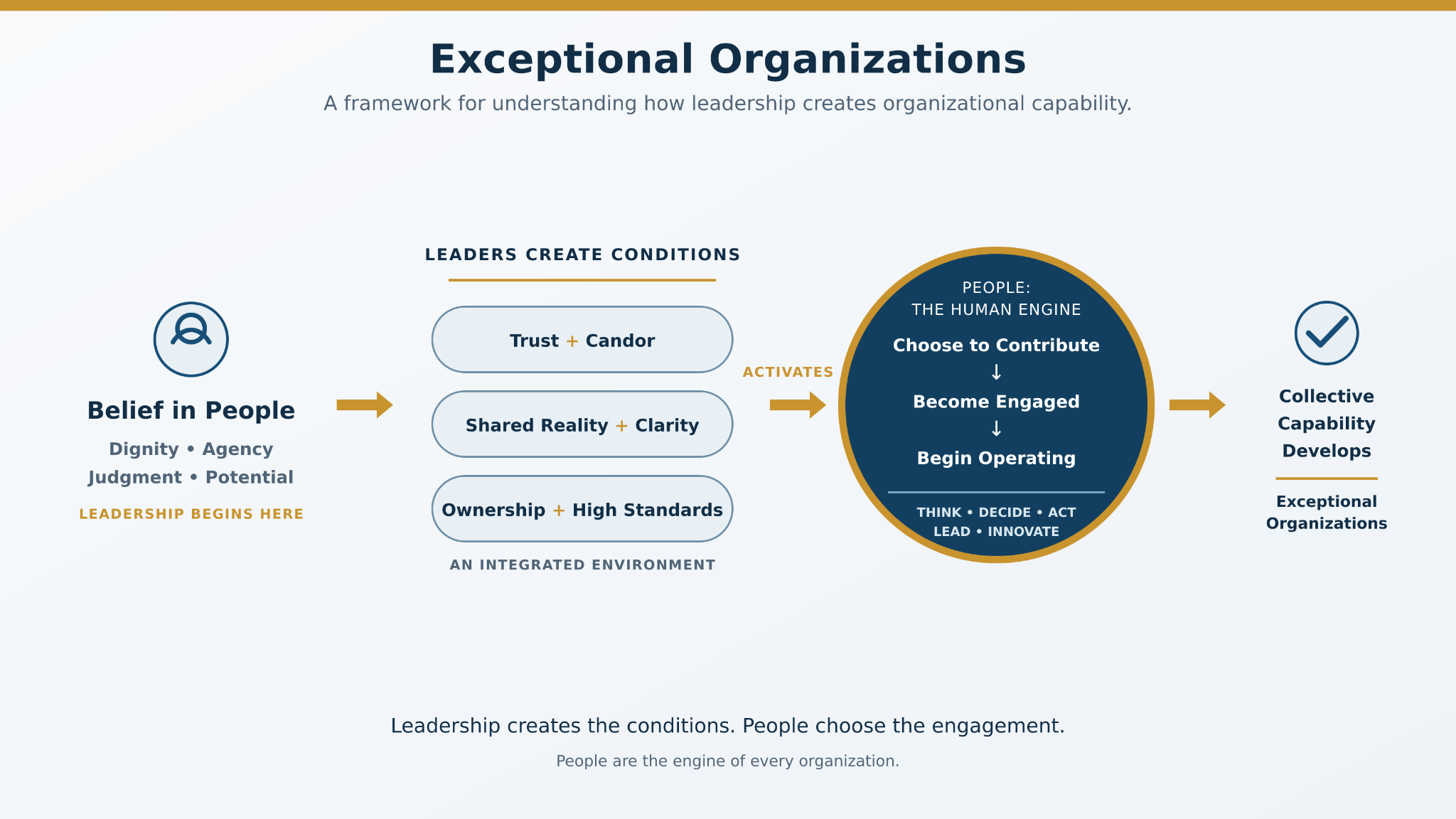
Trust makes candor possible, allows belonging to develop, and enables people to exercise human agency without excessive self-protection. Without trust, people protect themselves rather than contribute themselves.
People bring experience, talent, judgment, initiative, creativity, knowledge, dignity, agency, and potential. Leadership does not create the engine. Leadership creates the activating conditions that allow the engine to come to life.
Leadership cannot command commitment, engagement, initiative, or ownership. It creates conditions that make responsible contribution safe, meaningful, possible, expected, and supported.
Exceptional organizations do more than achieve results. Leadership develops people, distributes judgment, institutionalizes learning, strengthens systems, and prepares others to lead.
Leadership is not the accomplishment of extraordinary individuals acting alone. Leadership creates the conditions that enable people to think, decide, act, lead, innovate, and contribute together toward a shared purpose.
The phrase captures one of the central insights of Worth Following: sustainable success is built through people, not around them.
The philosophy begins with belief, moves through the conditions leaders create, activates the capability people already possess, builds collective capability, advances the mission, and creates the future. Leadership is measured not only by what an organization accomplishes today, but by the capability it develops for tomorrow.
Every philosophy raises a practical question. Worth Following becomes useful when its beliefs can be translated into a framework leaders can apply to real organizations.
No leader should have to do it alone.
If you are building something that matters—an organization, a leadership team, a culture, or a legacy—I would welcome the opportunity to learn what you are trying to accomplish and explore whether I can help.